
How to Brew Better Pour-Over Coffee: A Beginner’s Guide
There’s a reason pour over coffee has a near-cult following. When you get it right, it produces one of the cleanest, sweetest, most aromatic cups you can make at home — the kind of coffee that makes you slow down and actually taste what’s in the mug. And the good news is that it’s far less fussy than the ritual makes it look. You don’t need barista hands or a shelf of expensive toys. You need a few basics, a little attention, and an understanding of why each step matters.
This guide walks you through everything you need to brew a genuinely great pour over, even if it’s your very first time. We’ll cover the gear, the all-important coffee-to-water ratio, grind size, water temperature, the pour itself, and — maybe most usefully — how to taste your coffee and fix it when something’s off. By the end, you’ll have a repeatable method you can rely on every morning.
What pour over coffee actually is
Pour over is exactly what it sounds like: you pour hot water over a bed of ground coffee held in a filter, and gravity pulls the brewed coffee through into a cup or carafe below. It belongs to a family of brewing methods called infusion or drip brewing, and it’s prized for one main reason — control. You decide how fast the water moves, how evenly the grounds are saturated, and how long the whole thing takes. That control is what lets a careful brewer coax clarity and sweetness out of a coffee that a drip machine would leave flat.
The paper filter matters too. It traps the coffee’s oils and the finest particles, which is what gives pour over its signature clean cup — light-bodied, bright, and transparent in flavor. If you prefer a heavier, richer mug, you may actually prefer a French press, which uses a metal mesh and lets those oils through. Neither is better; they’re different pleasures. This guide is about getting the pour over version right.
What you’ll need
Here’s the short shopping list. Don’t be intimidated — you can start with very little and upgrade over time.
- Fresh whole beans. Ideally roasted within the last few weeks. Freshness matters more than almost anything else on this list.
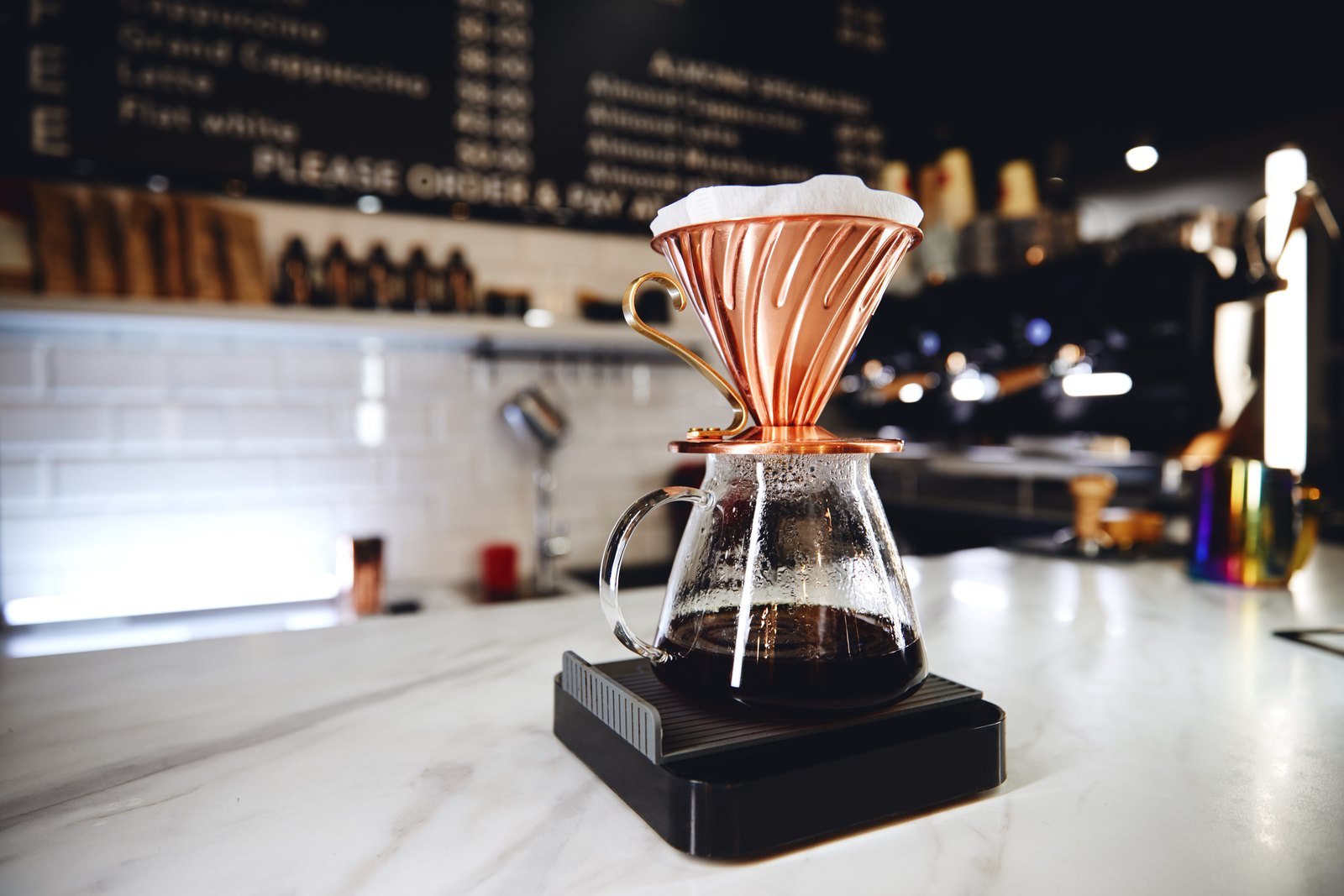
- A dripper. A Hario V60, Kalita Wave, Origami, or any cone-style brewer works. Each has a slightly different character, but the fundamentals are identical.
- Filters sized to fit your dripper.
- A burr grinder. The single biggest upgrade you can make for better coffee, and we’ll explain why below.
- A digital scale. Brewing by weight is the real secret to consistency — more reliable than any gadget.
- A kettle, ideally a gooseneck for pour control, though any kettle can work while you learn.
- Good-tasting water. If you’d happily drink it from the tap, you can brew with it. If your tap water tastes of chlorine or minerals, use filtered.
If you can only buy one thing from this list, make it the burr grinder. Pre-ground coffee goes stale within days and grinds unevenly, and uneven grounds are the number-one cause of a cup that tastes simultaneously sour and bitter. A burr grinder crushes beans to a uniform size, which means the water extracts flavor evenly. Blade grinders, by contrast, chop beans into a chaotic mix of dust and chunks — and that inconsistency shows up in the cup.
The golden ratio
The foundation of every good cup is the coffee-to-water ratio — how much coffee you use relative to how much water. For pour over, a great starting point is 1 gram of coffee to 16 grams of water, written as 1:16.
That sounds technical, but in practice it’s simple:
- 22 g coffee → 350 g water (one big mug)
- 30 g coffee → 480 g water (two cups)
- 15 g coffee → 240 g water (a single small cup)
Water weighs almost exactly 1 gram per milliliter, so 350 g of water is the same as 350 ml. This is precisely why the scale earns its place on your counter — measuring by weight is far more accurate than measuring by scoops. Two people each using “two scoops” can end up with wildly different strengths, because beans vary in size and density. Weight removes the guesswork.
Like your coffee stronger? Move toward 1:15. Prefer it lighter and more tea-like? Drift toward 1:17. The ratio is your master volume knob for strength, and it’s worth understanding deeply — we’ve written a whole companion piece on getting your coffee-to-water ratio right if you want to go further down that road.
Grind size: the texture that changes everything
For pour over, aim for a medium-fine grind — roughly the texture of table salt. Grind size controls how fast water flows through the coffee bed, and therefore how much flavor it pulls out.
Picture it this way. If your grind is too fine, the grounds pack tightly and water struggles to pass through. It lingers too long, dissolving harsh, bitter compounds — this is called over-extraction. If your grind is too coarse, water rushes straight through without pulling enough flavor, leaving you with a weak, sour, underwhelming cup — under-extraction. Medium-fine sits in the sweet spot where water flows at a pace that extracts the good stuff and leaves most of the bad behind.
You’ll dial this in by taste over a few brews, and we’ll show you exactly how in the troubleshooting section. For now, start at table-salt texture and adjust from there.
Water temperature and the bloom
Two more fundamentals before we pour.
Water temperature should land around 195–205°F (90–96°C) — just off the boil. Too hot and you scorch the grounds toward bitterness; too cool and you under-extract toward sourness. If you don’t own a thermometer, simply boil your kettle and let it rest for about 30 seconds before pouring. That short pause drops the water into the ideal range almost every time.
The bloom is the magic moment when hot water first hits fresh coffee. The grounds release trapped carbon dioxide, puffing up and bubbling like a rising loaf. This off-gassing is important: that CO2 actually repels water and causes uneven extraction, so we let it escape first. Pour just enough water to wet all the grounds, wait 30 to 45 seconds, and you’ll see the bed swell and settle. As a bonus, the bloom is a built-in freshness test — fresh beans bloom dramatically, while stale beans barely react at all.
Step-by-step: brewing your pour over
- Heat your water and weigh out your coffee while it comes up to temperature.
- Grind just before brewing. Coffee begins losing aroma within minutes of grinding, so this timing genuinely matters.
- Rinse the filter with hot water. This removes any papery taste and pre-warms your dripper and cup. Discard the rinse water.
- Add the grounds, give the dripper a gentle shake to level the bed, then set everything on your scale and tare it to zero.
- Bloom. Start a timer and pour just enough water to saturate all the grounds — about twice the weight of your coffee, so roughly 45 g of water for 22 g of coffee. Wait 30 to 45 seconds.
- Pour in slow, steady circles, starting at the center and spiraling outward, then back toward the center. Keep the water level steady rather than flooding the cone. Add water in two or three pours until you reach your target weight.
- Let it draw down. Your total brew time, from the first drop of the bloom to the last drip, should land around 2½ to 3½ minutes for a single cup.
That’s the whole method. Once it becomes muscle memory, the entire process takes about four minutes and feels like a small, satisfying ritual rather than a chore.
Troubleshooting: how to read your cup
Here’s the skill that separates good home coffee from great home coffee — learning to taste a cup and know what to change. Coffee gives you clear signals:
- Sour, thin, sharp, or grassy? The coffee is under-extracted. Grind a little finer to slow the water down, or pour a touch more slowly.
- Bitter, harsh, dry, or astringent? The coffee is over-extracted. Grind a little coarser, or check that your water isn’t too hot.
- Brewing too fast (under 2 minutes)? Your grind is too coarse — go finer.
- Brewing too slow (over 4 minutes) or clogging? Your grind is too fine — go coarser.
- Flat and lifeless? Your beans may be stale, or your water may lack the minerals that carry flavor. Try fresher beans or better water.
The golden rule of troubleshooting: change only one variable at a time, then taste again. If you adjust grind, ratio, and temperature all at once, you’ll never learn which lever did what. Move slowly and your palate will sharpen quickly.
Common mistakes that quietly ruin a cup
A few habits trip up almost every beginner. Skipping the scale and eyeballing scoops leads to inconsistency you can’t diagnose. Grinding too far ahead of time sacrifices aroma. Using water straight off a rolling boil scorches delicate coffees. Pouring too aggressively digs channels in the grounds so water races through unevenly. And reusing old, oxidized filters or a grinder caked in stale coffee oils can add musty flavors. None of these are hard to fix — they’re just easy to overlook.
Frequently asked questions
Do I really need a gooseneck kettle? No, but it helps. The narrow spout gives you precise control over where and how fast the water lands, which makes an even pour easier. A regular kettle works fine while you learn; just pour gently.
How fresh do the beans need to be? Aim to use beans within about a month of their roast date, and grind them right before brewing. Whole beans stored in an airtight container away from light and heat stay lively far longer than pre-ground coffee.
Can I make more than one cup at a time? Yes. Scale up using the same 1:16 ratio and a larger dripper, and expect the brew time to stretch a little. Very large batches are where a drip machine or a larger brewer starts to make sense.
Why does my coffee taste different every day? Usually it’s an unmeasured variable — a slightly different dose, grind setting, or water temperature. Lock those down with a scale and a consistent routine and your cup will steady out.
The one habit that matters most
If you remember nothing else from this guide, remember three things: grind fresh, weigh your coffee and water, and taste with intention. Those habits will do more for your coffee than any single piece of equipment you could buy. Everything else — the gooseneck kettle, the fancy dripper, the temperature-controlled machine — is refinement layered on top of those fundamentals.
Pour over rewards attention, and that’s exactly what makes it satisfying. You’re not just making coffee; you’re learning to taste, adjust, and improve, one cup at a time. Start with a 1:16 ratio and a table-salt grind, pay attention to what the cup tells you, and within a week or two you’ll be brewing coffee at home that rivals your favorite café.
Happy brewing — and once you’ve dialed in your pour over, try carrying those same habits over to a French press for a richer, fuller cup on slower mornings.

One Comment