French Press Coffee: How to Get a Rich, Clean Cup Every Time
The French press might be the most forgiving brewer ever made. There’s no paper filter to fuss with, no precise pour to master, no special skill to acquire — just coffee, hot water, and four minutes of patience. Done well, French press coffee gives you a full-bodied, richly textured cup with a depth that a paper filter simply can’t produce. It’s the method to reach for on a slow morning when you want something that feels indulgent.
Done carelessly, though, the French press produces exactly the cup its skeptics complain about: muddy, gritty, and over-bitter. The gap between those two outcomes comes down to a handful of small choices — the grind, the ratio, the timing, and one simple trick at the end. This guide walks you through all of them so you get the rich, clean cup every single time.
Why French press coffee tastes different
To brew it well, it helps to understand what makes this method distinct. Most brewers — drip machines, pour over cones — use a paper filter that traps the coffee’s natural oils and the finest particles. The result is a clean, light-bodied cup. The French press does the opposite. It uses a metal mesh screen, which lets those oils and a little fine sediment pass straight into your mug.
Those oils are the whole point. They’re what give French press coffee its signature heavier body, rounder mouthfeel, and lingering richness. But that same permeability is also why grind size matters more here than in almost any other method. Get the grind wrong and the mesh that delivers all that lovely body will also deliver a slurry of fine silt to the bottom of your cup. Master the grind and you get the richness without the mud.
This is technically an immersion brew
The French press belongs to a category called immersion brewing, where the coffee grounds sit fully submerged in water for the entire brew, rather than having water pass through them as in drip methods. Immersion is wonderfully consistent because every ground gets the same contact time with the water. That’s a big part of why the press is so forgiving — you’re not relying on a perfect pour, just a good steep. Understanding this also explains the troubleshooting later: with immersion, your main levers are grind size and time.
What you’ll need
- Fresh whole beans. As with any method, freshness is the foundation.
- A French press in any size. They’re inexpensive and last for years.
- A burr grinder. Especially important for this method, for reasons we’ll get to.
- A digital scale for a consistent ratio.
- A kettle. Any kettle works; no gooseneck required here.
Notice there’s no fancy gear on this list. The French press is the great equalizer of coffee brewing — what it asks of you is good beans and the right grind, not expensive equipment.
The ratio and the grind
Ratio. French press shines at about 1 gram of coffee to 15 grams of water (1:15) — a touch stronger than pour over, which suits the method’s bold, full character. In practice:
- 30 g coffee → 450 g water (a standard 3-cup / 12 oz press)
- 50 g coffee → 750 g water (a large 8-cup / 34 oz press)
If you want to understand how this number shapes strength and how to adjust it for any brewer, our guide to the coffee-to-water ratio breaks it down in detail.
Grind. Go coarse — think coarse sea salt or fresh breadcrumbs. This is the single most important variable in the entire method, so it’s worth getting right. Coarse grounds steep cleanly, plunge easily, and resist over-extraction during the long four-minute soak. Fine grounds do the opposite: they slip through the mesh as sludge, and because they have so much more surface area, they keep extracting throughout the steep and tip the cup into bitterness.
If your French press coffee has always come out muddy and harsh, your grind is almost certainly too fine. A good burr grinder fixes this instantly because it produces an even, genuinely coarse grind. Blade grinders struggle here — they can’t make a uniform coarse grind, so they leave you with a mix of boulders and dust, and the dust is what muddies your cup.
Step-by-step: brewing French press coffee
- Boil your water, then let it sit for about 30 seconds. You’re aiming for roughly 200°F (93°C) — just off the boil.
- Weigh and grind your coffee coarse, then add it to the empty press.
- Start a timer and pour in all your water at once, making sure every ground is saturated. Give it a gentle stir to settle any dry clumps.
- Place the lid on with the plunger pulled all the way up. This traps the heat, but don’t plunge yet.
- Steep for four minutes. Resist the urge to rush it — the time is doing the work.
- Break the crust. At four minutes, a layer of grounds will be floating on top. Stir it gently with a spoon and most of the grounds will sink. This is the simple trick that keeps your cup clean: skim off any foam and floating bits with a spoon before you plunge.
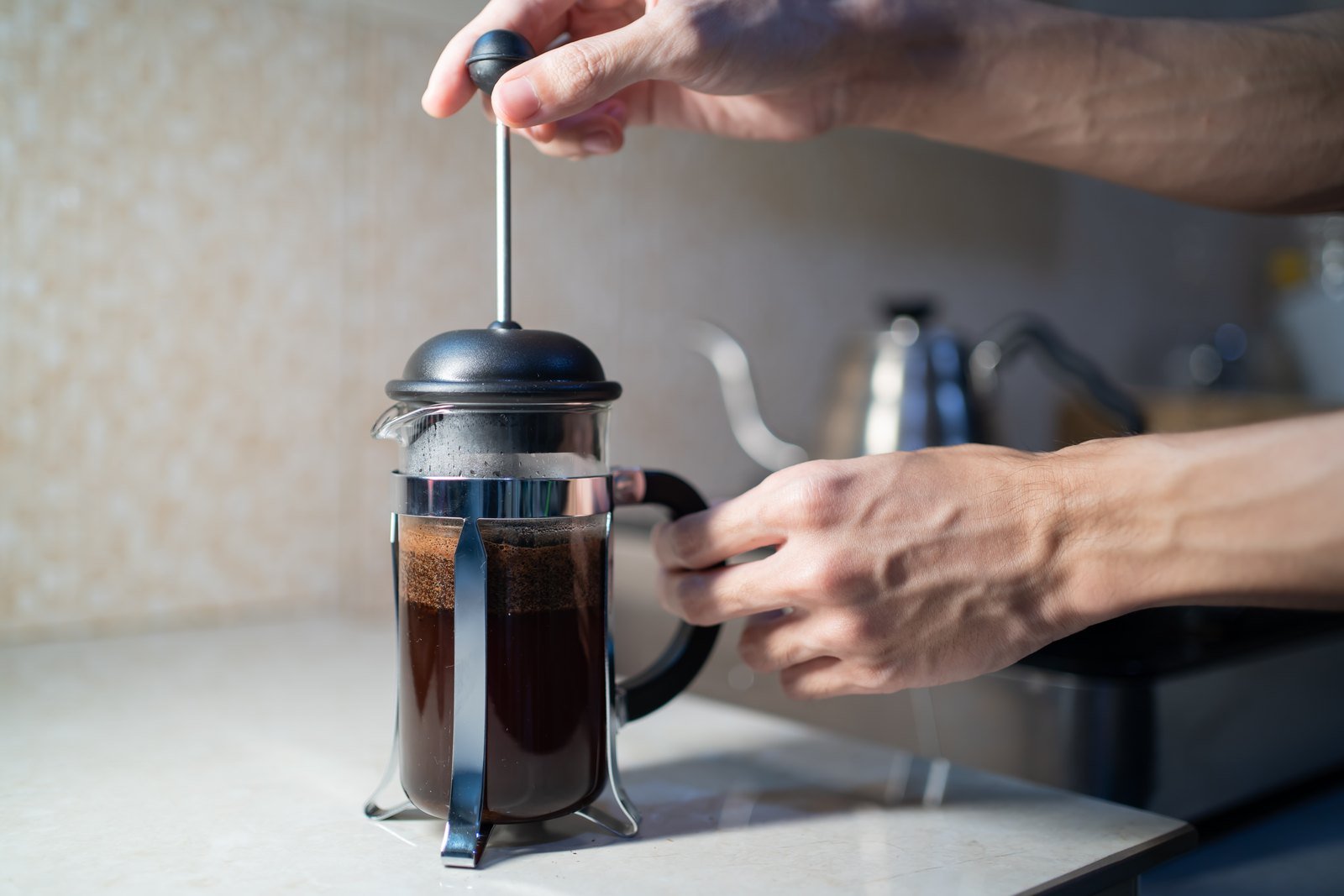
- Plunge slowly and steadily. If you feel heavy resistance, your grind is too fine; if the plunger drops with almost no resistance, it’s too coarse. Aim for gentle, even pressure all the way down.
- Pour it all out right away. Don’t let the coffee sit on the grounds in the press — it will keep extracting and turn bitter within minutes. If you’re not drinking it all at once, decant it into a carafe or second mug.
The trick that fixes a muddy cup
If you take one technique from this guide, make it the break-and-skim. After the four-minute steep, breaking the crust and then skimming the foam and floating grounds off the surface removes most of the fine particles that would otherwise end up in your cup. Combined with a coarse grind, it’s the difference between a press cup that’s rich and one that’s gritty. It costs you ten seconds and transforms the result.
Troubleshooting
- Muddy or gritty cup? Grind coarser, and be sure to skim the surface before plunging. A finer grind and skipped skim are the two usual culprits.
- Bitter or harsh? Grind coarser, shorten the steep slightly, and make sure you’re pouring the coffee off the grounds the moment it’s done.
- Weak or sour? Use a bit more coffee, moving toward a 1:14 ratio, and double-check that your water was hot enough — cool water under-extracts.
- Cold by the time you drink it? Pre-warm your mug and the press with hot water before brewing, and decant promptly.
A few small upgrades
Once the basics are second nature, two easy tweaks elevate the cup further. First, pour the coffee off the grounds the instant it’s done — this single habit prevents the slow slide into bitterness that ruins so many press cups. Second, pre-warm your mug with hot water so the brew stays hot longer; the French press loses heat faster than an insulated machine, and a warm mug buys you several more minutes of enjoyable temperature.
For the truly particular, a second pass through a paper filter or a fine mesh after plunging will give you a cleaner cup that keeps the body but loses the sediment — a nice hybrid if you love the richness but not the grit.
Cleaning your French press (and why it matters)
Here’s an overlooked truth: a dirty French press quietly sabotages good coffee. Because the method lets oils through, those oils also build up on the mesh screen, the plunger rod, and the inside of the carafe. Over time they go rancid, and stale, oily residue adds a musty, off-putting note to every cup — no grind adjustment will fix a flavor problem that’s actually coming from the equipment.
After each brew, knock the spent grounds into the trash or compost rather than the sink (wet grounds clog drains), then rinse the press thoroughly with hot water. Every week or two, disassemble the plunger — most unscrew into three or four parts — and wash each piece with a little dish soap to cut the oils, paying special attention to the fine mesh disc where residue collects. Rinse well so no soap lingers, and let everything dry fully before reassembling. A clean press tastes noticeably brighter, and the few extra seconds pay off in every cup that follows.
French press versus other methods
It helps to know where the French press fits among your options, so you can reach for the right brewer on the right morning. Compared with pour over, the press gives you a heavier body and more texture but less of pour over’s crisp clarity and bright, distinct flavor notes. Compared with a drip machine, the press offers more richness and control but takes a few minutes of hands-on attention rather than the push of a button. And compared with espresso, it’s gentler, larger in volume, and far more forgiving — no pressure, no fine-tuned machine, just time.
The practical takeaway: reach for the French press when you want a relaxed, full-bodied cup and have a few minutes to spare, and reach for pour o