
The Coffee-to-Water Ratio: The One Number That Fixes Most Home Coffee
If your coffee at home is inconsistent — great one morning, disappointing the next — there’s a good chance the culprit isn’t your beans, your grinder, or your machine. It’s your coffee-to-water ratio: how much coffee you use relative to how much water. Nail this one number and you’ll fix more bad cups than any gadget ever will. It is, without exaggeration, the highest-leverage thing you can learn about making coffee.
This guide explains what the ratio actually is, the numbers that work for each brewing method, a quick reference chart you can bookmark, and exactly how to dial it in to your own taste. Master it once and it applies to every brew you’ll ever make.
What “ratio” actually means
A coffee-to-water ratio is simply the proportion of coffee to water, written like 1:16 — meaning 1 gram of coffee for every 16 grams of water. Lower numbers (like 1:14) use more coffee per unit of water, making a stronger, more intense cup. Higher numbers (like 1:18) use less, making a lighter, more delicate one. That’s the entire concept. Everything else is just applying it.
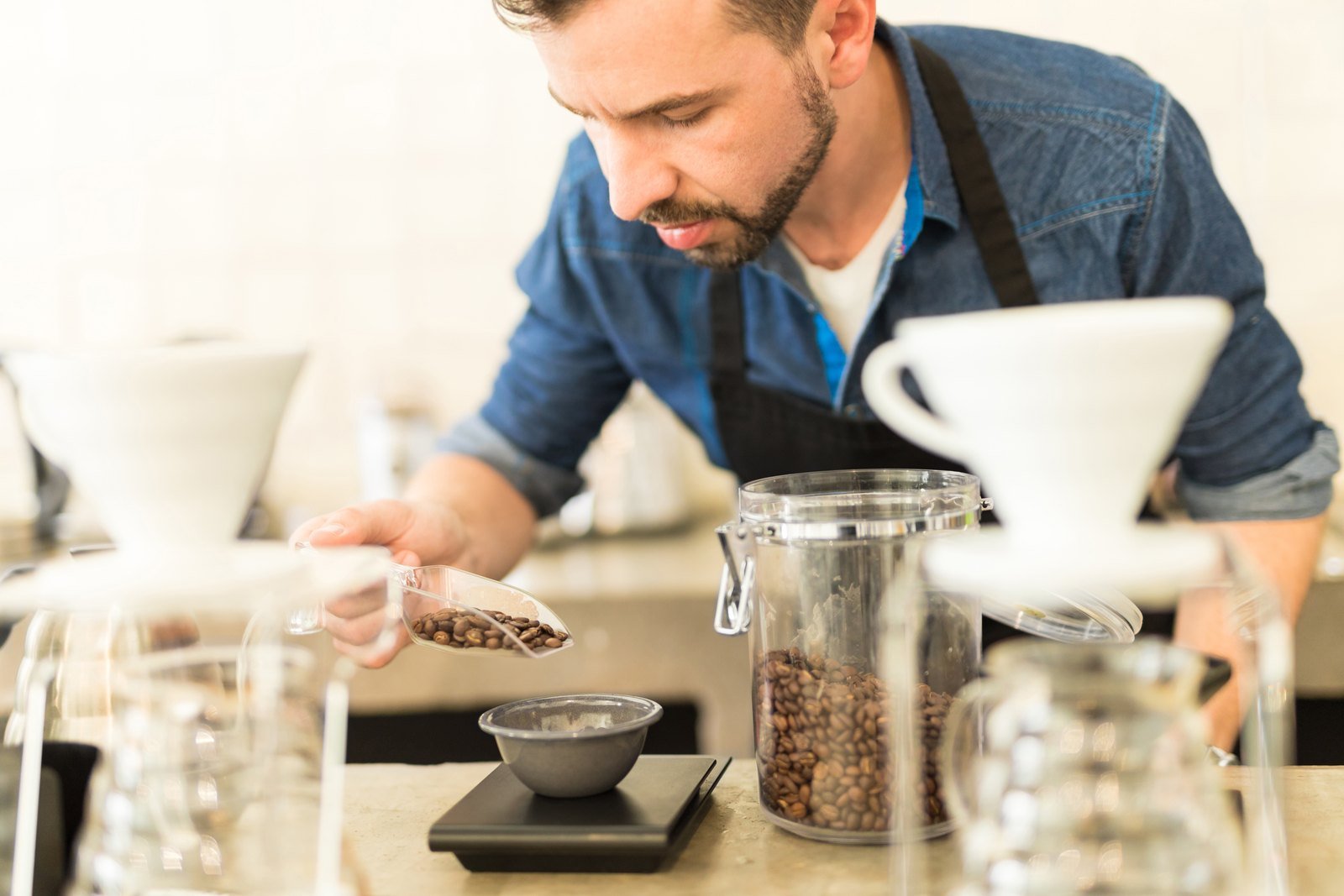
Notice we’re measuring in grams, not scoops or cups. That’s the real unlock. Coffee beans vary in size and density, so a “scoop” of one coffee can weigh quite differently from a scoop of another — sometimes by 20% or more. A tablespoon of dense, lightly roasted beans weighs more than a tablespoon of puffy, dark-roasted ones. Weighing your coffee, and your water, is how cafés produce the same cup every single time, and it’s the easiest professional habit to adopt at home.
A genuinely useful fact makes this painless: water weighs almost exactly 1 gram per milliliter, so 320 grams of water is the same as 320 ml. Your kitchen scale can handle the whole job — coffee and water both — no separate measuring jug required.
Why weighing beats scooping
It’s worth pausing on this, because it’s the habit that makes every other improvement possible. When you measure by volume — scoops, tablespoons, the lines on a carafe — you’re at the mercy of how the beans happen to settle and how big each bean is. The same scoop can hold meaningfully different amounts of actual coffee from one bag to the next. That’s why a recipe that worked perfectly last week can taste off this week: you changed beans, and your scoop quietly changed dose.
A scale removes that variable entirely. Once you know that, say, 22 grams of coffee and 350 grams of water make your perfect mug, you can reproduce it forever, with any beans, on any machine. A basic kitchen scale costs very little and is the closest thing to a guarantee of consistent coffee that exists.
The ratios that work, by brewing method
Different methods taste best at slightly different ratios, because they extract differently. Use these as reliable starting points, then adjust to your taste:
| Brew method | Starting ratio | Why |
|---|---|---|
| Drip / pour over | 1:16 to 1:17 | Clean and balanced; the all-rounder |
| French press | 1:15 | Stronger, suits its full body |
| Cold brew (concentrate) | 1:8, then dilute | Brewed strong, cut with water or milk to taste |
| Espresso | ~1:2 | A tiny amount of water, very intense |
For everyday drip and pour over coffee, 1:16 is the number to memorize. If you remember just that single figure, you’re 90% of the way to consistently good coffee. Brewing a French press instead? Nudge it to 1:15 for the fuller body that method does so well.
Quick reference chart (drip & pour over, at 1:16)
| Coffee | Water | Makes about |
|---|---|---|
| 15 g | 240 g | 1 small cup |
| 22 g | 350 g | 1 large mug |
| 30 g | 480 g | 2 cups |
| 60 g | 960 g | A small pot (4 cups) |
Want it stronger? Keep the coffee the same and use a little less water, moving toward 1:15. Want it lighter? A little more water, toward 1:17. Small changes make real, tastable differences — which is exactly why measuring matters.
How to dial it in to your taste
The “correct” ratio is ultimately the one you enjoy most. Here’s how to find yours in just three brews:
- Start at 1:16 and brew a cup, paying close attention to how it tastes.
- If it tastes weak, flat, or sour, you likely want more coffee — try 1:15 next time.
- If it tastes heavy, bitter, or muddy, ease off — try 1:17.
The key discipline: change only the ratio and keep everything else the same — same beans, same grind, same water temperature. By isolating that one variable, you’ll quickly zero in on your personal sweet spot instead of chasing your tail. Once you find it, write it down. That number is yours.
One important caveat: ratio isn’t the whole story
Here’s a distinction that clears up a lot of confusion. Ratio controls strength — how much coffee is dissolved in your water. But two other things control taste, and they’re easy to mix up with strength:
- Grind size, which sets how fast water pulls flavor from the grounds. Too fine extracts harsh, bitter compounds; too coarse leaves the cup thin and sour.
- Water temperature, ideally just off the boil, around 195–205°F (90–96°C). Too hot scorches; too cool under-extracts.
Think of it this way: ratio decides how strong your coffee is; grind and temperature decide whether it tastes good. A common mistake is to blame the ratio for a cup that’s actually suffering from a bad grind. So get the ratio right first — it’s the easiest win and the foundation — then fine-tune grind and temperature on top of it.
Adjusting for milk, iced, and large batches
A few real-world wrinkles worth knowing. If you take your coffee with milk, you may prefer a slightly stronger ratio — toward 1:15 — so the coffee still stands out once it’s diluted. For iced coffee, remember that the ice will melt and dilute your cup, so either brew stronger (less water) or brew directly onto the ice using a portion of your water budget as ice. For cold brew, you’re making a concentrate at around 1:8, then cutting it roughly half-and-half with water or milk when you serve — adjust that final dilution to taste. The underlying principle never changes; you’re just accounting for what gets added to the cup later.
Common ratio mistakes to avoid
Once you start measuring, a few predictable pitfalls tend to show up. Knowing them in advance saves you a lot of trial and error.
The first is chasing the ratio when the real problem is grind or temperature. If your coffee is bitter, the instinct is to use less coffee — but bitterness usually comes from over-extraction, which is a grind-and-temperature issue. Adjust those first and you may find your original ratio was fine all along.
The second is forgetting to account for absorbed water. Coffee grounds soak up and retain water — roughly two grams of water for every gram of coffee. For a single mug this is negligible, but when you scale up to a pot, that retained water means your finished volume is a little less than your input. If a big batch tastes slightly strong, this is often why; nudge your water up a touch.
The third is inconsistent dosing from an unreliable scale. A scale that only reads in whole grams, or that drifts, will undermine the precision you’re working for. A simple scale that reads to 0.1 gram removes the guesswork and is worth the tiny upgrade.
And the fourth is changing beans without re-checking. A new roast — especially a switch between light and dark — extracts differently, so a ratio that was dialed in for one bag may taste slightly off with another. Treat each new coffee as a quick three-brew recalibration and you’ll stay consistent.
A barista’s mindset on ratio
Professionals think about ratio as the anchor of a recipe, not a one-time setting. In a café, the ratio is written down, measured every time, and only adjusted deliberately — never by accident. That discipline is the entire reason your favorite shop’s coffee tastes the same on every visit. You can borrow the same mindset at home with almost no effort: pick your ratio, write it on a sticky note by the kettle, weigh every time, and change it only when you’re intentionally experimenting. What feels fussy for the first week becomes automatic by the second, and the payoff is a cup that’s reliably good rather than randomly good.
Frequently asked questions
What’s the best coffee-to-water ratio for beginners? Start at 1:16 for drip and pour over. It’s the most forgiving, balanced ratio and the easiest to adjust from once you know what you like.
How many grams of coffee per cup? At 1:16, a standard large mug of about 350 g of water needs roughly 22 g of coffee. Scale up or down with the chart above.
Do I really need a scale? If you want consistent coffee, yes. A cheap kitchen scale is the single most cost-effective coffee purchase you can make, because it makes every other improvement repeatable.
Why does my coffee taste bitter even at the right ratio? Bitterness usually points to grind or temperature, not ratio. Try a slightly coarser grind or slightly cooler water before changing the ratio.
The takeaway
Buy a cheap digital scale, memorize 1:16, and weigh both your coffee and your water. It costs almost nothing, adds about ten seconds to your routine, and it’s the closest thing to a guarantee of better coffee that exists. Get this one number right and your cup becomes consistent and predictable — and from there, every other refinement, from grind size to water quality, actually has a stable foundation to build on.
Ready to put it to work? Pair your dialed-in ratio with our pour over coffee guide or French press guide and brew your best cup yet.


One Comment