
How to Clean a Coffee Maker: A Step-by-Step Guide
Your coffee can only taste as good as the machine that makes it. If your morning cup has turned bitter, sour, or strangely flat — or if your brewer has slowed to a crawl — the culprit is almost always buildup inside the machine. Learning how to clean a coffee maker is one of the simplest, highest-impact upgrades you can make to your daily brew. This guide walks you through exactly why cleaning matters, how often to do it, and a step-by-step routine for both everyday rinsing and deep descaling.
Why cleaning your coffee maker matters
Two invisible problems build up inside every coffee maker over time, and each one ruins your coffee in a different way.
The first is coffee oil residue. Coffee beans are full of natural oils that carry much of their flavor and aroma. Those same oils cling to the inside of your carafe, brew basket, and machine. Fresh oils smell wonderful, but as they age and oxidize they turn rancid, leaving a stale, bitter taste that no amount of good beans can hide.
The second is limescale, also called mineral scale. Tap water contains dissolved minerals, mostly calcium and magnesium. Every time your machine heats water, a little of that mineral content gets left behind and hardens on the heating element and inside the water lines. Over months, this chalky scale insulates the heater, lowers the brewing temperature, slows the flow of water, and throws off your extraction so the coffee tastes weak or sour.
There is also a hygiene angle. The warm, damp reservoir and brew basket of a coffee maker are a comfortable home for yeast and mold if they are never cleaned. Regular cleaning keeps your machine not just tasting good but genuinely clean.
How often should you clean a coffee maker?
There are two cleaning rhythms to keep in mind, and they serve different purposes.
Daily: Rinse the removable parts — the carafe, the brew basket, and the permanent filter if you use one — after every use. This takes under a minute and stops oils from building up in the first place.
Every one to three months: Run a full descaling cycle to dissolve mineral scale. If you have hard water or brew several pots a day, lean toward monthly. With soft water and light use, every three months is usually fine. A good rule of thumb: if the brew cycle is taking noticeably longer than it used to, or the machine is sputtering, it is time to descale.
What you will need
The beauty of cleaning a coffee maker is that you almost certainly have everything already.
- White distilled vinegar — the classic, inexpensive descaler. Or a commercial coffee-maker descaling solution if you prefer.
- Water — ideally filtered, for the rinse cycles.
- Dish soap — for washing the removable parts.
- A soft sponge or cloth — avoid anything abrasive that could scratch.
- A small brush or old toothbrush — handy for the brew basket and tight corners.
How to clean a coffee maker step by step
This routine is written for a standard automatic drip coffee maker, which is the most common type. The same principles apply to most machines — rinse the parts, descale the water path, then rinse thoroughly.
Step 1: Empty and disassemble
Turn the machine off and unplug it. Discard any used grounds and the paper filter. Remove the carafe, the brew basket, and the permanent filter if your machine has one. Pour out any water left in the reservoir.
Step 2: Wash the removable parts
Wash the carafe, brew basket, and permanent filter in warm, soapy water. Use your sponge to wipe away the brown film of coffee oils that coats these parts — you will often be surprised how much comes off. For stubborn stains in a glass carafe, a paste of baking soda and a little water scrubbed gently will lift them. Rinse everything well and set it aside.
Step 3: Mix your descaling solution
Fill the water reservoir with a one-to-one mixture of white vinegar and water. For a standard 12-cup machine, that is roughly equal parts vinegar and water up to the full line. The vinegar’s acidity is what dissolves the mineral scale. If you are using a commercial descaler instead, follow the dilution on the package.
Step 4: Run a half cycle and let it soak
Place the empty carafe on the warming plate, put the brew basket back in (with a paper filter if you like, to catch any loosened debris), and start a brew cycle. Let it run until about half the solution has passed through, then turn the machine off. Letting the warm vinegar solution sit in the reservoir and lines for 30 to 60 minutes gives it time to break down the toughest scale. After the soak, turn the machine back on and let the rest of the cycle finish.
Step 5: Rinse, rinse, rinse
This is the step people rush, and it matters. Empty the carafe, refill the reservoir with fresh, clean water only, and run a full brew cycle to flush out the vinegar. Repeat this with fresh water at least one more time — two or three rinse cycles total. You want no vinegar smell or taste remaining, because even a trace will make your next pot taste sharp.
Step 6: Wipe down and reassemble
Wipe the exterior, the warming plate, and the area around the brew basket with a damp cloth. Make sure the parts you washed are dry, then reassemble the machine. Leave the lid open for a little while so the inside can air out completely — a closed, damp machine is exactly where mold likes to grow.
Cleaning other types of coffee makers
The core idea — wash the parts, descale the water path, rinse well — carries across machine types, with a few tweaks.
Single-serve pod machines: Empty and rinse the pod holder and drip tray regularly. To descale, run vinegar-and-water or descaler through the machine without a pod, using the largest cup setting repeatedly until the reservoir is empty, then rinse with several tanks of plain water. Check the needle that punctures the pod for clogs.
Espresso machines: These need more frequent attention because of the high pressure and milk involved. Wipe the steam wand immediately after every use and purge it. Backflush and descale according to the manufacturer’s instructions, since espresso machines are more sensitive than drip brewers. A clean machine is essential to getting a good shot, much like dialing in your coffee-to-water ratio.
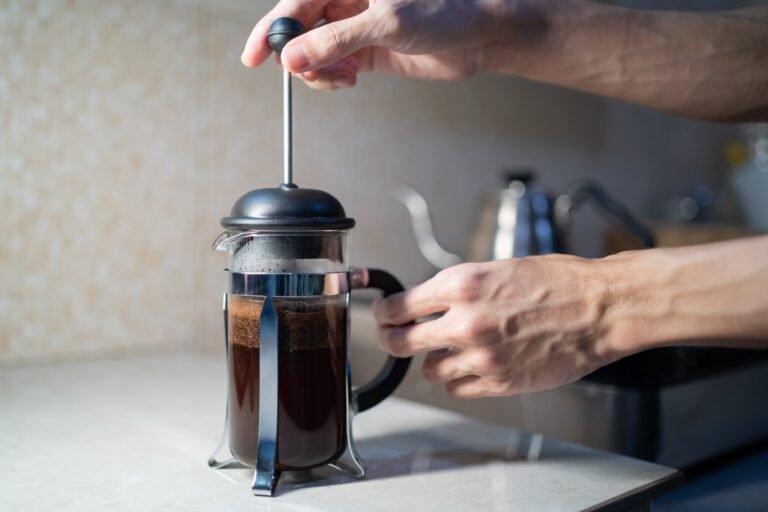
French press and pour-over: No descaling needed since they have no heating element, but do disassemble and wash them thoroughly. Coffee oils hide in the mesh of a French press plunger, so take the screen apart periodically and scrub each piece.
A few cleaning mistakes to avoid
Even a simple cleaning routine has a few pitfalls worth knowing.
- Skipping the rinse cycles. Leftover vinegar is the number-one reason a freshly cleaned machine makes bad coffee. When in doubt, rinse one more time.
- Using too much soap on the carafe and letting it linger. Soap residue also tastes off. Rinse parts until the water runs clear.
- Forgetting the reservoir lid and basket. These damp spots are where mold starts. Let them air-dry.
- Using abrasive scrubbers. Scratches give oils and scale more surface to cling to and can damage non-stick or glass surfaces.
- Ignoring the water you brew with. Using filtered water dramatically slows scale buildup, so you have to descale far less often.
Keep your beans fresh too
A spotless machine is only half the equation. Even the cleanest brewer cannot rescue stale beans, so pair your cleaning routine with good beans stored properly. If you are not sure what to buy, our guide on how to choose coffee beans is a good place to start. Fresh beans plus a clean machine is the combination that makes an everyday cup genuinely great.
The bottom line
Knowing how to clean a coffee maker comes down to two habits: a quick daily rinse of the removable parts and a monthly-to-quarterly vinegar descale of the water path, always followed by thorough rinsing. Coffee oils and mineral scale are the two enemies, and both are easy to defeat with vinegar, water, and a few minutes of attention.
Make this routine part of how you care for your machine and you will notice the difference immediately — faster brewing, cleaner flavor, and a coffee maker that lasts for years instead of months. Your future self, and your morning cup, will thank you.

One Comment